Direct Answer
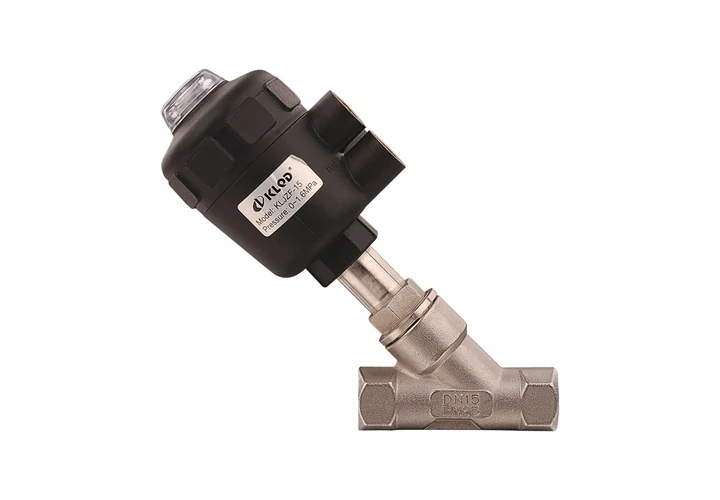
A stainless steel angle seat valve is a two-way, angle-pattern valve, usually air-actuated by a piston, used to start, stop or divert seawater, brine and treatment chemicals in a desalination plant. To specify one, match the valve port and flow coefficient (Cv) to your pipeline, choose a 304 or 316 stainless body for seawater and high-chloride media, and confirm the seal material, working pressure, control air pressure and solenoid voltage for the exact model.
Why Stainless Steel Angle Seat Valves in Desalination?
Desalination plants move aggressive media: raw seawater, brine, anti-scalant and cleaning chemicals. Carbon steel and standard brass bodies corrode quickly in chloride-rich water. A stainless angle seat valve resists chloride pitting and is easier to clean in place, which is why it is common on intake, pre-treatment and reverse-osmosis flushing lines.
Angle seat valves also offer good flow capacity and a low-pressure-drop path compared with a globe valve of similar size, and the angle pattern helps in compact skid layouts. Actual corrosion and pressure performance depend on the grade and the exact media, so confirm ratings with the supplier.
Buyer Checklist
| Parameter | What to confirm | Why it matters |
|---|---|---|
| Body material | 304 vs 316 / 316L stainless | 316/316L improves chloride resistance for seawater and brine |
| Port size & Cv | Match to pipe size and flow / pressure drop | Oversized or undersized valves hurt process control |
| Seal material | PTFE / FKM / EPDM | Must suit temperature and chemical compatibility |
| Actuator type | Single- vs double-acting pneumatic piston | Affects fail-safe behavior and air consumption |
| Working pressure | Max rated and control air pressure | Avoid leakage or actuator underperformance |
| Solenoid coil | DC24V, AC110/220V | Match to plant control voltage |
| End connection | Threaded, flanged, welded | Must match existing piping |
Selecting Stainless Grade and Actuator
For most desalination duty, 316 or 316L stainless is the safer default for wetted parts when the medium is seawater or high-chloride brine; 304 is acceptable for lower-chloride service. Confirm the seal material for the specific chemical: PTFE suits a wide range, while FKM or EPDM may be specified for particular media and temperatures.
Choose a single-acting (spring-return) actuator if the valve should close or open automatically on loss of control air, which is common for safety. Use a double-acting actuator when you want to hold position with compressed air. Exact pressure and temperature limits must be confirmed by model from the supplier.
Validating a Supplier for Desalination Duty
Before ordering, ask for the material certificate, the pressure and temperature rating table for the exact model, and a dimensional drawing of the connection. Send the plant medium, operating temperature, control media and voltage. Ask whether the solenoid and seal are rated for the chloride level, and whether custom ports, flanges or special seals are available. Confirm the minimum order quantity, lead time and sample policy for your configuration.
Send Your Desalination Valve Specs
If you are specifying angle seat valves for a desalination or water-treatment line, send the medium, temperature, pressure and port size, and include a drawing or photo of the current valve if you are replacing one. The team can review the configuration and match materials to your duty.
FAQ
What is the minimum order quantity (MOQ)?
MOQ is supplier-specific and varies by model, port size and material. Confirm MOQ with the supplier for the exact angle seat valve you plan to order.
How long is the lead time?
Lead time depends on stock, port size, material and actuator configuration. Ask the supplier to confirm a delivery window for your specific model.
What details should I send to confirm the model?
Send the pipeline medium, operating temperature and pressure, port and end connection, control air pressure and coil voltage. Include a drawing or photo of the current valve if replacing one.
Can I get a sample before ordering?
Many suppliers offer samples or prototypes. Confirm sample availability, cost and lead time directly with the supplier for your configuration.
Do you provide material certificates and drawings?
Request material certificates and dimensional drawings by model to verify compliance for the specific valve.
Sources
- User material: KLJZF series threaded-type pneumatic angle seat valve product image (Kailing product library)
- User material: site scan and customer material (pneumatic components / desalination)
- Manual confirmation needed: material certificates, pressure and temperature ratings and standards compliance by exact model
- Manual confirmation needed: MOQ, lead time, sample policy and custom options by model
Need a quotation?
Send the page link, quantity, drawings and working conditions to Kailing for review.