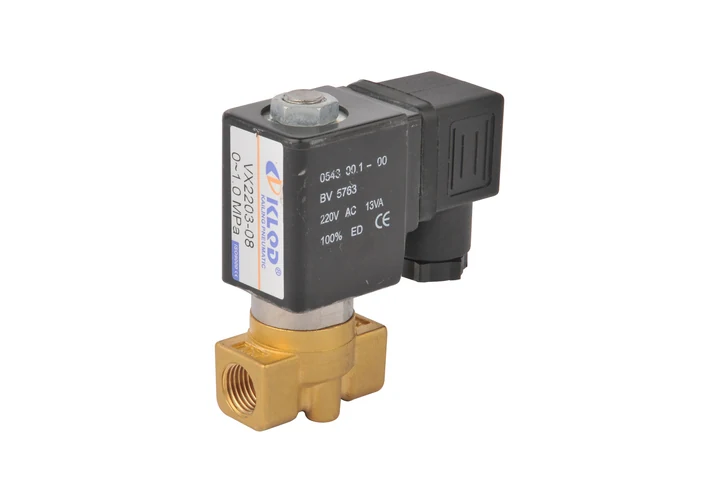
VX22 Series Vacuum Solenoid Valve: Direct-Acting Selection Guide
A vacuum line needs a direct-acting valve, because there is no line pressure left to drive a pilot piston or diaphragm. The Kailing VX22 series is a two-position, two-way direct-acting vacuum-type valve that starts from zero pressure differential, with 1.5 to 4.0 mm orifices and 1/8 or 1/4 in ports.
Key takeaways
- VX22 is direct acting, so it opens from zero differential: the property that decides vacuum duty.
- The pressure rating steps down as the orifice grows: 0-3.0 MPa at 1.5 mm, 0-1.0 MPa at 4.0 mm.
- Seal options are NBR, EPDM, VITON and silicone, each with its own temperature range.
Why does a vacuum line need a direct-acting valve?
A pilot-operated valve needs a minimum pressure differential to push the seal open. On a vacuum line the pressure sits below atmosphere on both sides of the seat, so that differential is missing and the coil must do all the work. The VX22 lifts the seal with coil force alone, so it is catalogued as direct acting and starts from zero pressure.
What does the VX22 range cover?
| Model | Orifice | Port | Pressure differential (catalog) |
|---|---|---|---|
| VX2215 | 1.5 mm | 1/8 or 1/4 in | 0-3.0 MPa |
| VX2220 | 2.0 mm | 1/8 or 1/4 in | 0-2.5 MPa |
| VX2225 | 2.5 mm | 1/8 or 1/4 in | 0-2.0 MPa |
| VX2230 | 3.0 mm | 1/8 or 1/4 in | 0-1.6 MPa |
| VX2240 | 4.0 mm | 1/8 or 1/4 in | 0-1.0 MPa |
Orifice and pressure rating move in opposite directions: a wider bore gives more flow, but the same coil force must close a larger seat area. The 0-3.0 MPa figure belongs to the 1.5 mm orifice only.
How do I size the orifice for a vacuum application?
Start from the flow you must pass at your working vacuum level, not from the maximum pressure figure. At a low differential a small orifice chokes the flow, so a 1.5 mm valve that looks strongest on paper can be the weakest for evacuating a chamber or driving a suction cup. If the valve only ever sees vacuum and light pressure, take the largest orifice whose rating still covers the duty.
Which seal and temperature range should I specify?
| Seal | Code | Media temperature (catalog) | Typical fit |
|---|---|---|---|
| NBR | blank | -5 C to +80 C | General air, water and vacuum duty |
| EPDM | E | -10 C to +120 C | Hot water and water-based media |
| VITON | V | -10 C to +150 C | Higher temperature and aggressive media |
| Silicone | SI | -15 C to +150 C | Low-temperature flexibility |
In vacuum service the elastomer also affects outgassing and leak rate, which this table cannot show, so send the medium and the vacuum level for confirmation.
Which coil, voltage and protection options apply?
Catalog voltages are DC 12 V, DC 24 V, AC 24 V, AC 110 V, AC 220 V and AC 380 V at 50 Hz or 60 Hz. Coil power is quoted as AC 25 VA and DC 12 W. The coil is a fully encapsulated thermoset plastic type with an ISO-standard socket and IP65 protection. A timer coil is listed for periodic switching duty, and an explosion-proof coil where the area classification demands it.
How do I read a VX22 ordering code?
A code such as VX2220-08-V-G-AC220V reads in parts: VX22 for the series, 20 for the orifice code (15, 20, 25, 30 or 40), 08 for the port code, the seal letter (blank, E, V or SI), the coil option (blank or T), the thread standard (G, ZG or NPT) and the voltage.
Buyer checklist before an RFQ
| Item | What to state | Why it matters |
|---|---|---|
| Function | Vacuum switching, vacuum holding, or both | Sets the leak-test requirement |
| Vacuum level | Working vacuum in kPa or mbar | Shows the seat holds when de-energised |
| Pressure duty | Any positive pressure the valve also sees | The rating depends on orifice |
| Orifice | 1.5, 2.0, 2.5, 3.0 or 4.0 mm | Sets flow and rated differential |
| Port | 1/8 or 1/4 in, plus thread standard | Must match the field connection |
| Medium and temperature | Air or gas, normal and peak | Drives the seal choice |
| Coil | AC or DC voltage, frequency, power | Must match the panel supply |
| Quantity | Pieces per order, plus spares | Delivery and packing |
Is the VX22 available as a custom or OEM build?
The ordering code already fixes the orifice, port, seal, coil option, thread and voltage, so a private-label project can be built around those choices plus brand marking and packing. Anything outside the code needs an engineering review.
Frequently asked questions
Can a pilot-operated solenoid valve be used on vacuum?
Not as a standard selection. A pilot valve needs a pressure differential to open, and a vacuum line does not provide one.
Is the VX22 suitable for holding vacuum on suction cups?
A direct-acting, zero-pressure-start valve suits that duty because it seals at zero differential. Confirm the seal material, the allowed leak rate and the switching frequency.
Can the coil be supplied for a hazardous area?
The catalog lists an explosion-proof coil option for this family. Send the area classification so the matching option can be checked.
Need a VX22 quotation for your vacuum line?
Send the function, the working vacuum, any positive pressure the valve sees, the orifice and port with thread standard, the medium and temperature, the coil voltage and the quantity.
Need a quotation?
Send the page link, quantity, drawings and working conditions to Kailing for review.