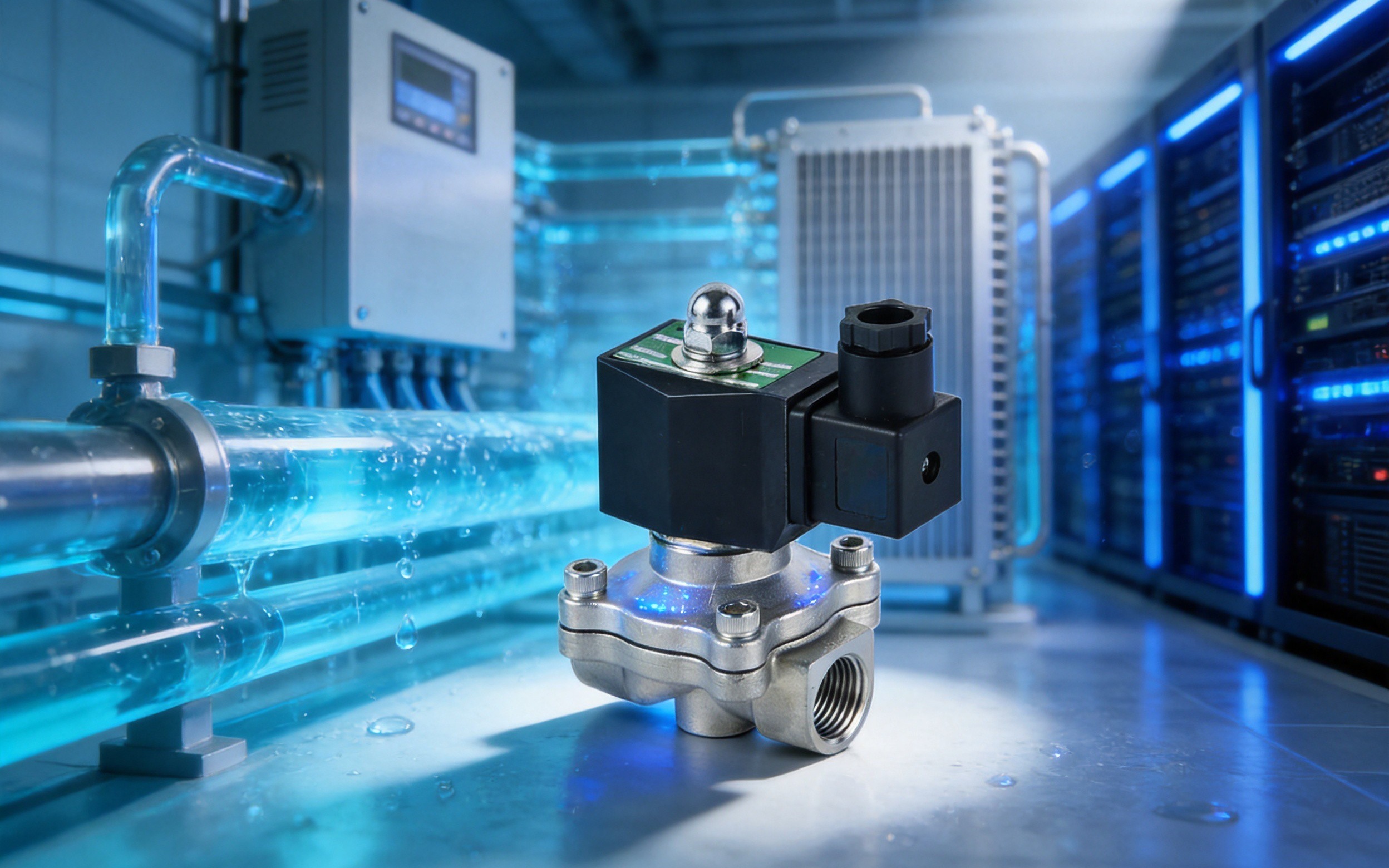
2WB160-15-E-S Stainless Steel Solenoid Valve: EPDM Diaphragm & IP65 Coil for AI Liquid Cooling and Industrial Water Systems
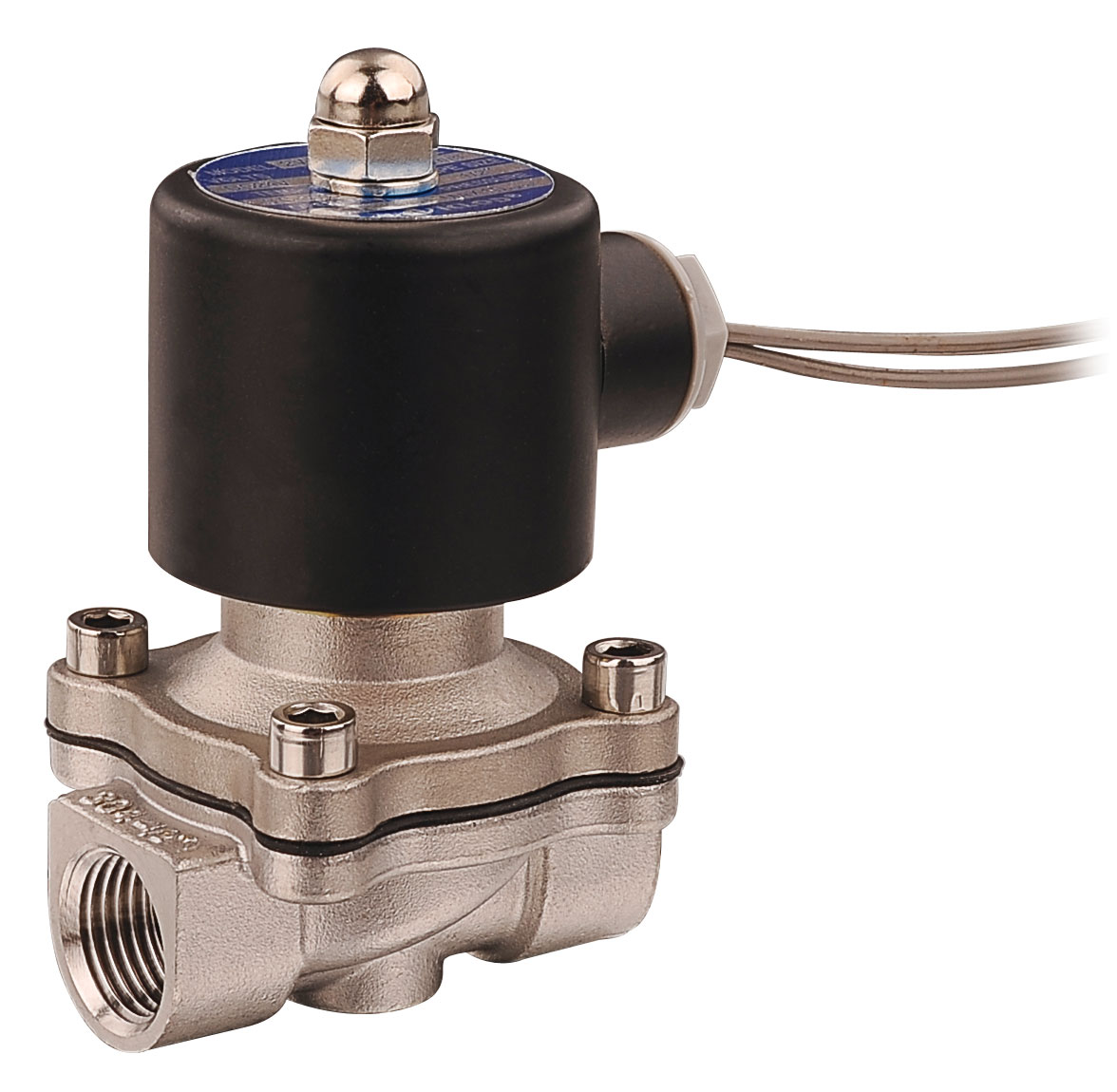
The Kailing 2WB160-15-E-S is a 2/2-way, normally closed, direct-acting stainless steel solenoid valve with a 16 mm orifice, G1/2 (DN15) ports, an EPDM diaphragm and an IP65-rated square coil. It is rated for water at 0–0.7 MPa and media temperatures from -10 °C to +120 °C with the EPDM seal — a working envelope that covers AI liquid-cooling CDU loops, water-glycol circuits, industrial cooling-water lines and washdown equipment, where a brass body or an NBR seal is the wrong choice.
Key takeaways
- 2WB160-15-E-S: 16 mm orifice, G1/2 (DN15) port, EPDM seal, IP65 square coil, CV 4.8.
- Direct-acting diaphragm valve — opens from zero pressure differential, normally closed as standard.
- Media temperature -10 °C to +120 °C with EPDM; water pressure 0–0.7 MPa.
- Built for AI liquid-cooling CDU manifolds, glycol coolant loops, cooling-water circulation and humid washdown areas.
Key data at a glance
| Parameter | Value |
|---|---|
| Orifice | 16 mm |
| Port | G1/2 (DN15), G or NPT thread |
| Seal | EPDM diaphragm |
| Coil protection | IP65 square coil (code S) |
| Media temperature | -10 °C to +120 °C (EPDM) |
| Water pressure | 0–0.7 MPa |
| CV value | 4.8 |
The model code reads as follows: 2WB = stainless steel fluid solenoid valve, 160 = 16 mm orifice, 15 = 1/2 in port, E = EPDM seal, S = square IP65 coil, with the voltage appended — for example 2WB160-15-E-S-DC24V.
Why choose the 2WB160-15-E-S for liquid cooling duty?
EPDM diaphragm vs NBR diaphragm: why liquid cooling specifies EPDM
The seal material decides whether a fluid solenoid valve survives in a cooling loop. AI liquid-cooling circuits carry water-glycol coolant with supply and return temperatures commonly in the 45–65 °C band, plus hot-water flushing during commissioning and service. EPDM keeps continuous margin up to +120 °C media; NBR tops out at +80 °C.
| Comparison | NBR (Buna-N) | EPDM (code E) |
|---|---|---|
| Media temperature | -5 °C to +80 °C | -10 °C to +120 °C |
| Hot water and steam | Fair | Excellent |
| Ozone and UV ageing | Poor | Excellent |
| Mineral oil and fuels | Excellent | Not suitable |
| Typical media | Oil, fuel, air, neutral water | Hot water, water-glycol coolant, deionized water, weak acid/weak alkali |
In the 45–65 °C return-water band where liquid-cooling loops actually run, EPDM holds a large continuous-temperature margin and resists the hot-water and ozone exposure that hardens NBR over time. The reverse also matters: EPDM is not for oil-based media. If the circuit carries oil or fuel, order the same 2WB160-15 body with an NBR or FKM seal instead — the valve is catalogued with NBR, EPDM, VITON and silicone seals.
What the IP65 coil actually protects in a liquid-cooling cabinet
IP65 means dust-tight and protected against low-pressure water jets from any direction. Inside a CDU (coolant distribution unit) cabinet, three moisture sources are real and routine: condensation on chilled lines, slow seepage at pipe fittings, and wipe-down or rinse during maintenance. A bare IP00 or IP20 coil in that environment invites insulation tracking, terminal corrosion and eventual short circuit. The square coil (code S) with IP65 sealing is the baseline specification for humid electrical rooms and washdown areas, and it is offered across the 2W and 2WB solenoid valve range so mixed installations use one coil family.
Stainless steel body vs brass body
Deionized and low-conductivity coolants are aggressive toward brass: the water leaches copper and zinc from the alloy, which contaminates the coolant and corrodes downstream copper cold plates and fittings. That is why brass 2W valves are specified for ordinary water and air, while the 2WB series uses 304 stainless steel (316 on request) for the wetted parts. Stainless is compatible with deionized water, water-glycol mixtures and common fluorinated heat-transfer fluids, and it also carries the weak-acid and weak-alkali media the 2WB series is catalogued for.
Technical specifications: 2WB160-15 with EPDM seal and IP65 coil
| Parameter | Value |
|---|---|
| Model | 2WB160-15-E-S |
| Body material | Stainless steel 304 (316 on request) |
| Seal / diaphragm | EPDM |
| Valve type | 2/2-way diaphragm, normally closed |
| Action | Direct acting — opens from zero pressure differential |
| Orifice | 16 mm |
| Port | G1/2 (DN15); NPT thread available |
| CV value | 4.8 |
| Pressure range | Water 0–0.7 MPa; air 0–1.0 MPa; oil 0–0.9 MPa (with suitable seals) |
| Media temperature | -10 °C to +120 °C (EPDM) |
| Ambient temperature | -5 °C to +60 °C |
| Coil | Square coil, IP65 (code S); AC 18 VA / DC 16 W |
| Standard voltages | AC 24/110/220/380 V (50/60 Hz); DC 12/24/36/110/220 V |
| Suitable media | Water, water-glycol coolant, deionized water, weak acid/weak alkali, air |
Direct action matters in cooling loops: the valve opens from zero pressure differential, so it can be energized before the pumps build head during a startup or standby sequence. The 2WB series itself extends from 4 mm to 50 mm orifices and G1/8 to G4 ports, so larger mains step up to 2WB250-25, 2WB500-50 or the flanged 2WBF family.
Application scenarios
1. AI data center liquid cooling: CDU loop shutoff
G1/2 (DN15) is one of the most common piping sizes for CDU manifolds and rack-level supply/return headers. The 16 mm orifice with CV 4.8 provides adequate flow capacity for main-circuit shutoff at that size, the EPDM diaphragm is compatible with water-glycol coolant, and the direct-acting design opens reliably at zero differential during pump-start sequences. The IP65 coil suits the humid electrical environment of a coolant cabinet.
2. Rack manifolds and cold-plate branch groups
A single GPU cold plate usually takes a G1/4 branch line; this G1/2 valve belongs one level up — on the manifold header, the make-up/fill and drain lines, or as the inlet control for a branch valve group. A practical pattern is 2WB160-15 on the group inlet paired with smaller 2WB040/2WB050 valves (G1/8–G3/8, 4–5 mm orifice) on individual branches, all sharing the same IP65 square coil family.
3. Industrial cooling-water circulation
In HVAC chilled and condenser-water loops, injection molding machine cooling, and laser equipment water chilling, the stainless body handles circulating and softened water better than brass, which scales and pits over years of warm-water duty. Normally closed action gives a fail-safe position: power loss closes the valve. Direct opening from zero differential also matters on gravity-fed or low-head circuits.
4. Cleaning equipment and water treatment
EPDM tolerates neutral cleaning solutions and weak acid/weak alkali process water, which matches spray washers, parts cleaning machines and dosing or transfer lines in water treatment skids. The IP65 coil keeps the electronics safe in humid, hose-down workshop areas. For any specific chemical, send the name, concentration and temperature — the factory confirms body, seal and diaphragm compatibility before quoting.
Installation and maintenance points
- Thread sealing: G (BSP parallel) threads seal on the end-face O-ring or gasket, not on the thread flanks. Do not wrap PTFE tape on G threads — tape belongs on NPT tapered threads only. Tape fragments migrating into the valve are a leading cause of stuck diaphragms.
- Engagement and torque: engage at least 6 full threads on the G1/2 joint. A typical assembly torque for DN15 stainless threaded joints is 22–28 N·m; always follow the specification of the mating fitting, and support the valve body so piping stress is not transferred into the ports.
- Inlet filtration: install a strainer upstream of the valve. Particles in coolant loops are what hold a diaphragm seat open or jam the armature.
- Orientation: install with the pipe ports inclined or horizontal and the coil not hanging below the valve body. Coil-up or horizontal mounting keeps settled impurities away from the armature area.
- Water hammer: fast-closing solenoid valves in liquid loops can generate pressure spikes. Fit accumulators or dampeners on long runs, or ramp pump start/stop, to protect seals and gauges.
- Periodic exercise and inspection: in standby loops, cycle the valve at least every 30 days so the armature stays free; inspect joints and the coil every 6 months.
Common troubleshooting reference
| Symptom | Probable cause | Action |
|---|---|---|
| Valve will not open | Coil burned out; supply voltage too low | Replace coil; verify rated voltage at the coil terminals |
| Valve will not close | Particle holding the diaphragm seat; aged diaphragm | Flush and clean the body; replace the EPDM diaphragm |
| Coil overheats | Armature stuck while energized | Remove debris; check armature movement and media cleanliness |
| Leak at the port | Damaged face O-ring; insufficient torque | Replace the O-ring; re-tighten to the specified torque |
Frequently asked questions
Is the 2WB160-15-E-S suitable for glycol-water coolant in AI liquid cooling?
Yes. The EPDM diaphragm is compatible with water-glycol mixtures across the full -10 °C to +120 °C media rating, and the 304 stainless body resists deionized water and glycol solutions. Coolant loops run well below the 0–0.7 MPa water pressure limit. Send the coolant brand and concentration for a written compatibility confirmation.
What is the difference between the EPDM seal and the standard NBR seal?
EPDM carries media from -10 °C to +120 °C versus -5 °C to +80 °C for NBR, and it performs clearly better with hot water, steam and ozone exposure. NBR remains the correct choice for oil-based media — the same 2WB160-15 body is available with NBR or FKM seals for oil duty up to 0.9 MPa.
Can this valve be used in a CDU main circuit?
The G1/2 (DN15) port matches common CDU manifold piping and the 16 mm orifice (CV 4.8) provides adequate flow for supply/return shutoff at rack level. For larger mains the 2WB series extends to G4 ports, and the 2WBF flanged family covers flanged installations up to DN50.
What does the IP65 coil rating cover?
IP65 means the coil is dust-tight and protected against low-pressure water jets — the right rating for humid electrical rooms, condensation-prone cabinets and wipe-down maintenance. It is not a submersion rating: the valve is not designed for continuous immersion.
What are the MOQ and lead time?
Standard 2WB models are produced in volume, with low MOQ for stock configurations. Custom orifice sizes (for example 6 mm), special seals, voltages and thread standards are supported under OEM terms, with EXW/FOB/CIF delivery. Exact MOQ and lead time depend on the configuration and quantity — send the model and volume for a firm schedule.
Quality, OEM capability and how to request a quote
Ningbo Kailing Pneumatic Co., Ltd has manufactured solenoid valves and pneumatic components since 2003 and is ISO 9001 and CE certified. Every valve is hydrostatically tested at 1.5× rated pressure with a 5-minute hold and air-leak checked before shipment. OEM and ODM support covers custom orifice sizes, seal compounds, coil voltages and thread standards, so liquid-cooling integrators can standardize one valve family across a cabinet build.
To request a quotation, send the model (or the medium, pressure, port size, body material and voltage), the quantity and the working conditions through the contact page, or review the full 2WB stainless fluid solenoid valve series. A photo or drawing of the existing installation speeds up the review.
Need a quotation?
Send the page link, quantity, drawings and working conditions to Kailing for review.