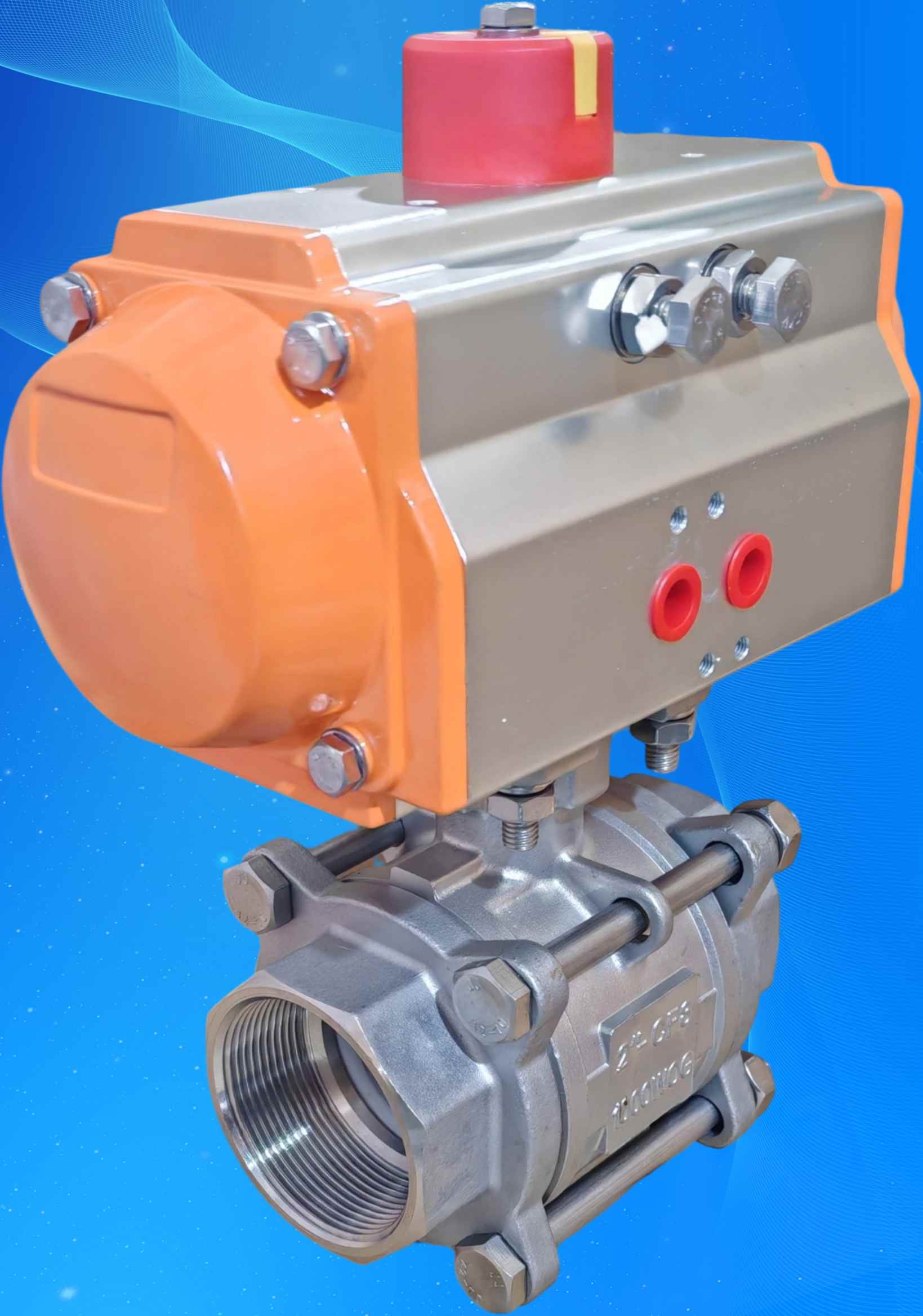
What Is a Pneumatic Ball Valve and Why Use It in Petroleum Service?
A pneumatic actuated ball valve is a quarter-turn isolation valve turned by compressed air through a rack-and-pinion actuator instead of a hand lever. It suits oil and gas because it can be operated remotely, strokes 90 degrees plus or minus 5 degrees for quick isolation, and needs only instrument air in the field. Typical locations: crude oil transfer and gathering lines, tank farm and terminal isolation, refined product and gas lines, produced water circuits and refinery pipework. For large or high-torque lines, trunnion designs may suit - consult us.
Q-Series Pneumatic Ball Valve Specifications
KAILING Q-series valves cover DN10-DN200 (3/8"-8"), 1.6 / 2.5 / 4.0 MPa, and -20C to +180C with standard soft seats.
| Item | Specification |
|---|---|
| Size range | DN10 - DN200 (3/8" - 8") |
| Body material | WCB cast steel; SS304; SS316 (UPVC/CPVC for chemical media) |
| Seat / seal | PTFE; modified PTFE (TFM); alloy steel; hard alloy |
| Pressure class | 1.6 / 2.5 / 4.0 MPa |
| Media temperature | -20C to +180C soft-seated; metal-seated above (consult us) |
| Connections | Thread (internal/external), flange, welding, wafer, clamp, union |
| Structures | Floating 2-way; floating 3-way L-port; floating 3-way T-port |
| Actuator | AT-series rack-and-pinion; double-acting or spring-return; 90 degrees plus or minus 5 degrees |
| Actuator torque | 3.6 Nm (AT-32) to approx. 4,500 Nm (AT-300) |
| Actuator ambient | -20 to +80C standard; -35 to +80C low temp; -20 to +150C high temp |
| Interface / mounting | NAMUR (VDI/VDE 3845) top pad; ISO 5211 |
| Enclosure | IP65 / IP66 / IP67 |
| Certifications | ISO 9001; CE; Exia II BT6 / Exdm II BT6 solenoids; T4/T6 |
Torque tables for each AT model are on our AT-series pneumatic actuator page.
Seat and Seal Material vs. Media and Temperature
Choose the seat from the media first, then confirm the temperature window. Soft seats cover -20C to +180C and hard alloy suits abrasive service.
| Seat material | Typical service | Temperature |
|---|---|---|
| PTFE | Clean crude oil, refined products, water, gas | -20C to +180C |
| Modified PTFE (TFM) | General petroleum service where specified | -20C to +180C |
| Alloy steel | Higher-duty lines to project specification | Confirm with KAILING |
| Hard alloy | Abrasive, high-wear service e.g. sand-bearing fluids | Confirm with KAILING |
| Metal-seated | Above the standard soft-seat range | Above +180C - consult us |
If the stream carries sand, scale or catalyst fines, specify a hard-alloy seat before increasing actuator size.
Actuator, Fail-Safe Mode and NAMUR Accessories
AT-series actuators span 3.6 Nm (AT-32) to about 4,500 Nm (AT-300), double-acting or spring-return, 90 degrees plus or minus 5 degrees. Spring-return is usual for oil and gas isolation, moving the valve to a defined position when air is lost; double-acting suits lines with a permanent air supply. The NAMUR (VDI/VDE 3845) pad accepts solenoid valves and limit switch boxes, ISO 5211 bolts directly to the valve, ambient versions cover -20 to +80C, -35 to +80C and -20 to +150C, and enclosures reach IP65, IP66 or IP67.
How to Choose a Pneumatic Ball Valve for Oil Industry Applications
- Media. Crude, refined product, gas, produced water or chemical - this sets body and seat materials.
- Size and pressure class. Match the pipe DN and confirm 1.6, 2.5 or 4.0 MPa; above DN200 or high torque, trunnion designs on request - consult us.
- Body material. WCB for hydrocarbon duty, SS304 or SS316 for corrosive or coastal sites; UPVC/CPVC only for chemical media.
- Seat material. PTFE or modified PTFE for clean crude, alloy steel where specified, hard alloy for abrasive streams, metal-seated above the soft-seat range.
- Actuator torque. Send valve size, media and air supply pressure so the AT actuator is sized on actual torque, including breakaway on dirty media.
- Fail-safe mode. Spring-return for a defined position on air failure; double-acting where powered movement both ways is needed.
- Ambient and accessories. Gulf ambient fits -20 to +80C; near hot equipment use the -20 to +150C version. Add NAMUR solenoid valve, limit switch box, ISO 5211 mounting and the end connection - flange, thread, union or wafer.
Compliance: What Is Standard and What Needs Discussion
Standard scope is ISO 9001 and CE, with intrinsically-safe Exia II BT6 and flameproof Exdm II BT6 solenoid valve options and IP65/IP66/IP67 actuators. ATEX, IECEx, NACE MR0175, API 6D, API 607 fire-safe, SIL and operator-specific approvals are not in our standard scope. For projects requiring ATEX/IECEx or NACE compliance, contact KAILING to discuss certification options and what your project must certify separately.
FAQ
What size pneumatic ball valve do I need for a crude oil pipeline? Match the pipe DN - Q-series covers DN10-DN200 (3/8"-8"). Above DN200 or for high-torque pipeline duty, consult us on trunnion designs.
Do pneumatic ball valves work in 50C Middle East heat? Yes. Standard AT actuators are rated -20 to +80C ambient, covering Gulf summer conditions; use the -20 to +150C version near hot equipment.
Spring-return or double-acting actuator for oil & gas? Spring-return is usual for isolation, giving a defined position on air failure; double-acting suits lines with a permanent air supply.
Can you supply valves for sour service or NACE MR0175 projects? Not in our standard scope; send material and hardness requirements with your RFQ and we will discuss what can be supported.
Do I need ATEX or IECEx certified equipment? Not in our standard scope; we offer Exia II BT6, Exdm II BT6 and T4/T6 solenoid options with IP65-IP67 actuators. Contact us for your area classification.
What is the lead time from China to Jebel Ali? Confirmed in writing with each quotation; it depends on size, materials, actuator configuration and quantity. EXW, FOB or CIF from Ningbo to Jebel Ali and Dammam.
Request a Quotation for Your Oil & Gas Project
Send your drawings, datasheet or P&ID extract with media, line size, pressure class, temperature, actuator mode and destination port. We quote EXW, FOB or CIF from Ningbo to Jebel Ali, Dammam and other Gulf ports. Request a quotation with your specification.
Need a quotation?
Send the page link, quantity, drawings and working conditions to Kailing for review.